Rare factory 3.8-litre specification, the most powerful and sought-after XK150 variant
It was originally delivered with four-wheel disc brakes, a feature that was not standard on early XK 150 models. Having factory-installed four disc brakes enhances both safety and collectability
One of just 532 examples produced
Just between 80 to 180 3.8-litre Drophead Coupes are estimated to survive today
A reasonable estimate of how many 3.8-litre Jaguar XK150 Drophead Coupés in original Black paint might still exist today is of between 12–27 cars
The powerful 3.8 engine, elegant black coachwork, luxurious Mulberry red interior, factory overdrive, and four-wheel disc brakes together create a car that is extremely collectible
First owner preserved the car for nearly half a century (48 years)
Expertly restored to the highest standards
Thanks to decades of dry Californian storage before restoration, the body retained an exceptionally solid and corrosion-free structure. As a result, the restoration required minimal structural intervention
Exceptional provenance with complete original documentation
From its origins in the 1920s to its post-war transformation into a global symbol of British performance, Jaguar built its reputation on a rare combination of racing pedigree and aristocratic refinement.
By the late 1950s and early 1960s, Jaguar stood at a fascinating crossroads.
The company had already conquered endurance racing, most notably at the 24 Hours of Le Mans, and had proven that British engineering could rival, and often surpass, continental competitors.
Yet Jaguar was not content to be merely a racing legend, it sought to dominate the grand touring market as well.
The XK models had started in 1948 and evolved steadily through the XK120 and XK140.
By the time the Jaguar XK150arrived, Jaguar had refined its formula into something more mature, more luxurious, and more powerful than ever before.
The XK150 Drophead Coupé was the most sophisticated open-top expression of the XK lineage.
Unlike the more aggressive Roadster, the Drophead emphasized comfort without sacrificing performance.
It featured roll-up windows, a lined convertible top, improved seating, and a broader grille that gave it a more imposing presence.
The introduction of the 3.8 litre inline-six engine in 1959 was the final and most powerful development of the original XK powerplant.
Enlarged from the earlier 3.4 litres, the 3.8 offered increased torque and smoother high-speed cruising.
This was no longer simply a sports car, it was a refined grand tourer capable of crossing continents at remarkable speed.
The XK150 also marked the end of the classic hand-finished XK era. After it, Jaguar moved decisively into a new design language with the E-Type and later grand tourers.
Production of the XK150 ran from 1957 to 1961, with approximately 9,382 units built across all variants.
Just 532 Jaguar XK150 Drophead Coupés were produced with the 3.8-litre engine, making this configuration exceptionally rare.
That means just about 7% of total XK150 production consisted of Drophead Coupés fitted with the larger 3.8 engine.
A rough survival estimate for high-end British sports cars of this era is 20–30% of original production.
Between 80–180 3.8-litre Drophead Coupes could plausibly survive today.
Black was a common but not dominant colour compared with traditional British colours like British Racing Green, red tones, or light greys.
A reasonable estimate of how many 3.8-litre Jaguar XK150 Drophead Coupés in original Black paint might still exist today is of between 12–27 cars.
ABOUT THIS SPECIFIC EXAMPLE
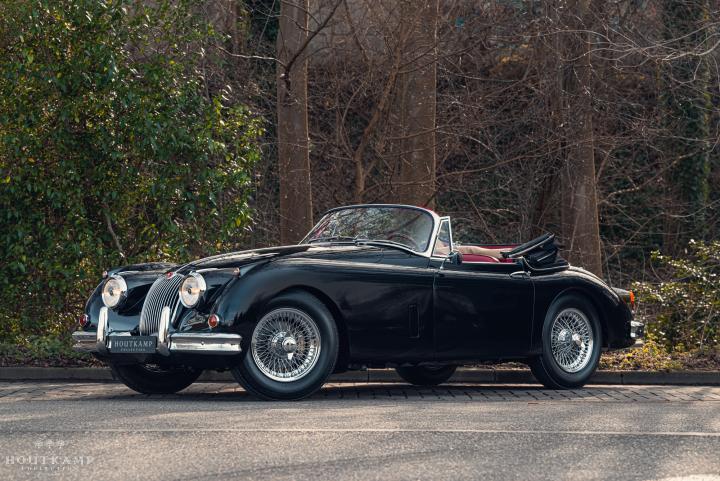
This specific example is not just another XK, it is one of the rarest configurations ever produced: a 1960 Jaguar XK150 Drophead Coupé 3.8 Litre.
Delivered new in 1960 in California, USA, this Jaguar spent its early life in one of the most favorable climates imaginable.
By 1968 it had already been taken off the road and stored in a dry garage in the warm Californian climate, arguably the best preservation scenario for a classic British sports car.
Thanks to these ideal conditions, the car retained an exceptionally solid and corrosion-free structure.
In 1999, the car was purchased directly from its first owner by a passionate Dutch Jaguar enthusiast known for his uncompromising restoration standards.
Determined to return the car to perfection, he undertook a meticulous, multi-year nut-and-bolt restoration.
Every component was carefully inspected, restored, or renewed where necessary, always with respect for originality and authenticity.
When completed, the result was a Jaguar restored to superb condition, both cosmetically and mechanically.
This 1960 Jaguar XK150 Drophead Coupé 3.8 Litre is an exceptionally elegant and highly desirable specification, combining rarity with striking aesthetics and outstanding mechanical features.
The car is finished in deep black, a colour that enhances the powerful yet graceful lines of the XK150. Black gives the car a timeless, almost formal presence.
The sculpted bonnet, wide grille, and flowing rear wings appear even more defined in this finish, making the car both elegant and imposing.
Opening the door reveals a stunning Mulberry red leather interior, a rich and luxurious shade that perfectly complements the black exterior.
The contrast between the dark bodywork and the warm red leather creates a classic and highly attractive colour combination that feels both sporting and sophisticated.
This particular example is equipped with overdrive, a highly desirable feature that significantly improves driving comfort. The overdrive reduces engine revs, making long-distance touring more relaxed and refined.
Even more noteworthy, this car was originally delivered with four-wheel disc brakes.
At the time, disc brakes were still a relatively advanced and performance-oriented technology, derived from Jaguar’s racing experience.
Having factory-installed four disc brakes enhances both safety and collectability, underlining the car’s high specification from new.
CONDITION EXTERIOR
Overall, the exterior condition can best be described as exceptional. It combines originality, structural integrity, and meticulous restoration quality.
Finished in deep black, the car presents with a powerful yet formal presence. The dark paintwork enhances the sculpted lines of the XK150, emphasizing the long bonnet, the wide and purposeful front grille, and the beautifully flowing rear wings.
Thanks to decades of dry Californian storage before restoration, the body retained an exceptionally solid and corrosion-free structure. As a result, the restoration required minimal structural intervention. There was no need for extensive welding or panel replacement, preserving the car’s originality and factory integrity.
The paint finish is deep and lustrous, with excellent clarity and shine. The body panels are straight and precisely aligned.
Notably, original construction features such as factory welding points remain visible rather than being overly smoothed or concealed, underscoring the authenticity of the work carried out.
The chrome trim is superb, providing a crisp contrast against the black bodywork.
The bumpers, grille, window surrounds, and other brightwork elements are all beautifully finished, adding refinement without overpowering the car’s clean lines.
CONDITION INTERIOR
The interior conveys warmth, depth, and craftsmanship. The Mulberry red leather adds character and richness, while the overall execution reflects the meticulous nut-and-bolt restoration the car has undergone.
The seats have been fully restored using period-correct materials, carefully matched in texture, grain, and finish to the original specification.
The door panels and interior trim are finished with precise stitching and clean lines.
There is no over-restoration or excessive refinishing, the interior retains the authentic character of a properly restored original car rather than a modern reinterpretation.
The dashboard maintains the classic XK150 layout, with beautifully restored gauges and instruments, all functioning perfectly.
As a Drophead Coupé, the hood plays an important role in the overall interior experience.
The lining is neatly fitted and finished with care.
Many restored Drophead Coupés suffer from noticeable gaps between the side windows and the hood.
This example shows excellent alignment.
DRIVING EXPERIENCE
It offers a uniquely satisfying driving experience, advanced engineering for its era, and genuine rarity within Jaguar production history.
At the wheel of the Jaguar XK150 Drophead Coupé, the sensation is unmistakably that of a true 1960s grand touring sports car: powerful, mechanical, and deeply engaging.
With strong torque throughout the rev range, the car feels effortlessly capable.
Acceleration is smooth yet assertive, accompanied by the distinctive, refined growl that defines classic Jaguar performance.
The presence of factory four-wheel disc brakes, still an advanced feature at the time, transforms the driving confidence of the car.
Braking is progressive and reassuring, far superior to many contemporaries still relying on drums.
Combined with precise steering and a well-balanced chassis, the XK150 offers a driving experience that is both composed and involving.
With overdrive fitted, long-distance touring becomes particularly enjoyable. At cruising speeds, engine revs drop noticeably, allowing the car to settle into a relaxed and refined rhythm.
For collectors and enthusiasts alike, it represents one of the most compelling and refined open grand tourers of the early 1960s.
The 3.8 Drophead one of the rarest and most desirable configurations within the XK150 range.
Just between 80 to 180 3.8-litre Drophead Coupes are estimated to survive today.
Well-restored, numbers-correct examples with documented history, particularly those preserved in dry climates and restored from highly original bases, are increasingly sought after.
Price on request